
Dear Amigos,
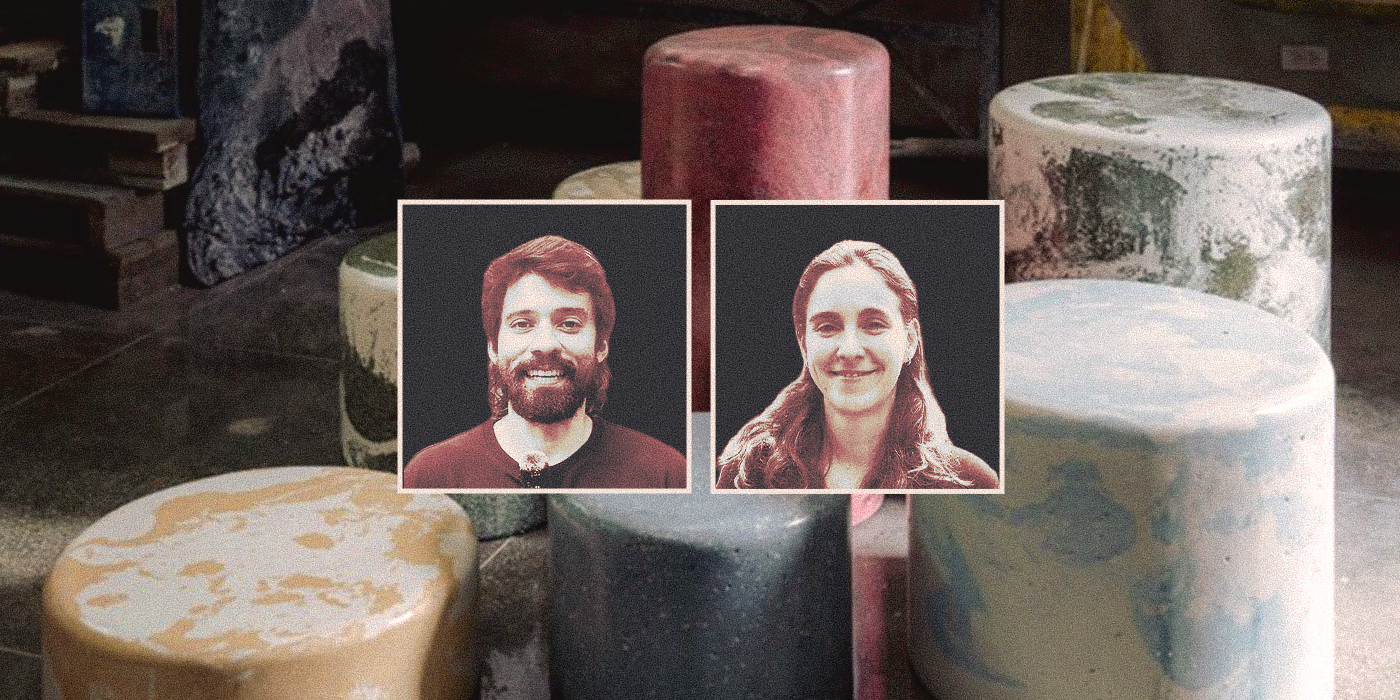
In our ongoing interest in the venezuelan design scene, we connected with Cajuña, an industrial design studio born in 2020 that took concrete, a material essential to Venezuelan architectural history since the country’s first National Cement Factory opened in 1909, and pushed it into combinations and colors we never imagined possible. Under the creative direction of Adriana Toth, with Augusto Rivera and Gonzalo Rivas leading the operational side, Cajuña takes concrete out of the purely structural (columns, beams, slabs) and into a space of design, color, and innovation.
This interview was conducted in June 2026, on the occasion of Cajuña’s installation at Caracas Design Week, just days before the earthquakes that shook the country. If you’d like to see current ways to help those affected, you can do so here.

What is Cajuña?
Augusto: Cajuña is a project and studio that’s almost multidisciplinary, working across architecture, industrial design, and interior design, always centered on concrete as our base material — though we mix in others, from clay to fiberglass, to get these pieces made. Concrete always carries that connotation of being a rough, gray, outdoor material. A few years ago, we set out to change that meaning: to shift it from a material for structures to one that, using granite, terrazzo, and Venetian casting techniques, produces pieces that care about detail and aesthetics without compromising on creativity.

Where does the name Cajuña come from?
Augusto: Cajuña is a deity from Maquiritare mythology. For us, it was important that anyone who came across our work would know it was made by people who live in Caracas and speak Spanish — hence the ñ, which is always present.
Adriana: It was also important that the name be catchy and unique, something you couldn’t find anywhere else except in that Rómulo Gallegos novel. That gave the project a value all its own.

How did you approach Cajuña’s branding? What typeface did you use?
Adriana: The branding has been a work in progress. It’s not very expansive, it’s actually quite simple. What I wanted was to bring together the idea of simplicity and the weight of the material in the logo. We used Futura Bold, which has very orthogonal strokes, and I feel it reflects the material we work with. From the logo, we experimented our way into the isotype and the rest of the brand’s visual family. From the start, Cajuña has been an experimentation with color, so it was necessary to keep that separate from the branding itself, the branding stays deliberately sober so it doesn’t compete with the pieces.

What sets Cajuña apart from other industrial design projects?
Augusto: Through color, we managed to pull concrete out of its traditional canon and into a pictorial experimentation that mixes texture, materials, and color. And because it’s impossible to control every aggregate that goes into a piece, each one ends up unique, even when it’s a single color. Everything is made by hand — it’s a genuinely artisanal process, done by young people who put everything into it. Every piece carries the personal imprint of whoever cast it, polished it, sealed it. Powder, cement, sand, and stone go into the workshop, and what comes out is a piece with a purpose, an aesthetic, and an emotional weight that goes well beyond its use.
Adriana: It’s been important for us, as a brand, not to box ourselves in. We never wanted to be seen as just a supplier of industrial design in concrete: we made curbs, then sinks, then took on projects where we’re always experimenting. We no longer think of ourselves as concrete suppliers, but as an industrial design studio, and that opens the door to new kinds of projects.

Adriana, you come from graphic design and the film industry. How have those experiences shaped the creative you are today?
Adriana: Since I studied design, color was something that really caught my attention, and that same curiosity shows up in Cajuña today: everything started with color, back in that early experimentation stage when it was just Augusto and me. Working in film production in Europe for three or four years taught me how to coordinate a large team so the work actually got done well, and I wanted to bring those high standards to the team we have now. Cajuña is also about wanting to work with your hands — to make something physical, not just something on a screen — and when you create that object, you want it to be as close to perfect as possible, because you’re presenting it to someone.

As Villanueva once put it, concrete is liquid stone: it can be poured into any mold and adapted to any scale, from a bathroom fixture to the city itself. That, at its core, is what Cajuña does — it doesn’t reinvent the material so much as it reinvents the question of what it can become.
If you’re in Caracas, Cajuña’s installation is currently at Centro Comercial Tolón, Las Mercedes. It’s worth seeing up close, and worth following along on Instagram and on their website.
A type of Ari.